

Batteries Beyond EVs
How India’s battery ecosystem is powering the next generation of mobility, defence, and autonomy.
If Next in Line studies the companies approaching the public markets, Under the Hood studies the forces creating them.
This series explores the industries, market shifts, capital cycles, and structural trends that shape tomorrow’s category leaders.
Today, we go under the hood of India’s battery sector.
The Thesis
Somewhere in a lab in the 2010s, an electric car taught the world that a battery could be a product you paid for the same way you paid for the phone in your pocket. Over the next decade, it’s going to teach the world something bigger: that a battery can be an entire company, with its own founders, its own funding rounds, its own reason to exist that has nothing to do with the vehicle sitting on top of it. India, of all places, is where both of those lessons are colliding first.
Every big hardware shift has one boring part that turns out to be the whole story. Personal computing had the microprocessor. Mobile had the modem chip nobody could name. This time, it’s the battery. It used to be the last thing an engineer picked, bolted on after the vehicle was already designed. Now it’s the thing everything else gets built around, and the company that owns it can capture the value even if it never makes a single vehicle.
This piece is a bet on two places where that’s already happening.
Bet one: India is betting that battery swapping can succeed where earlier global attempts failed. The difference is not the technology, but the customer. Instead of targeting private EV owners with home charging, the model is built around high-utilization commercial fleets where every hour spent charging translates into lost earnings. If fleet density continues to scale, swapping could become the dominant refueling model for last-mile mobility.
Bet two, and this is the one we think is bigger: the battery is turning into the one thing holding back drones, defence robotics, humanoid machines, and short-hop electric aircraft, and whoever wins that race won’t be a drone company at all. Here’s the tell. An Indian FPV drone tender got scrapped last year, not because nobody could build the drone, but because twenty to thirty bidders couldn’t prove they’d built the battery, the motor, or the flight controller themselves. India can draw up a drone airframe just fine. What it can’t yet reliably do is build the battery that keeps that drone flying for eight hours instead of forty minutes, shrugs off a Himalayan winter, and doesn’t catch fire the moment it takes a hit. That single gap is why Amprius, Lyten, SES AI, and Factorial Energy now get valued like defence-tech companies rather than battery vendors, and why a handful of Indian startups are working this exact problem.
Pull both bets apart and you find the same wire running underneath. At every layer of the battery, from the raw lithium in the ground to the chemistry in the cell to the software watching over it to what happens when it dies, the money is moving away from whoever owns the vehicle and toward whoever owns the battery itself. We’ve been calling this the value accrual ladder. It’s the idea the rest of this piece keeps climbing back down to.
The Value Accrual Ladder
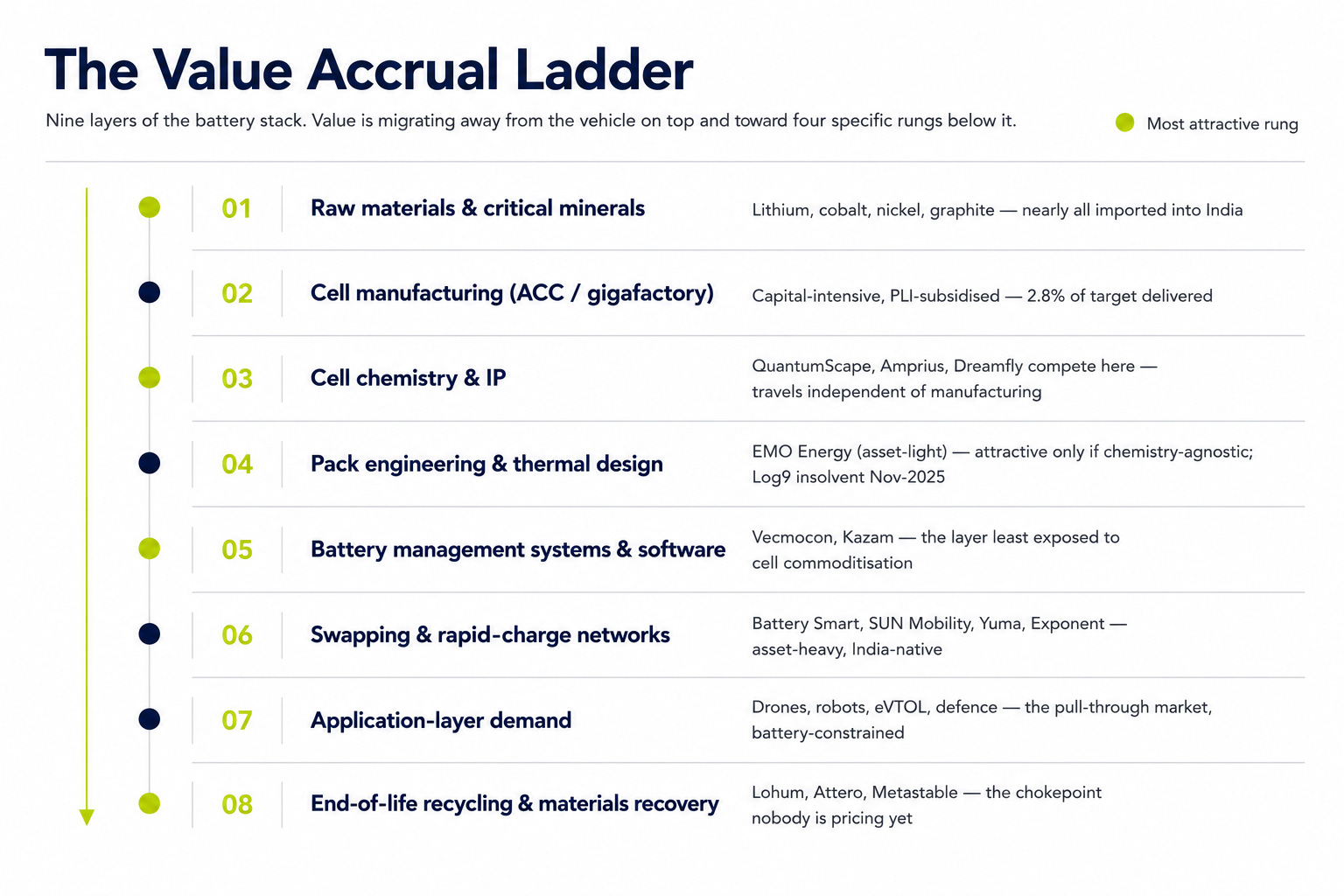
The vehicle or drone sitting on top of this stack is, increasingly, the least differentiated part of it.
Part I - Battery Swapping: Why India Could Become the Global Leader
Every other market that tried swapping treated it as a convenience feature for people who already owned a charger. India is building it as the only viable refuelling infrastructure for people who never had one.
Why it failed everywhere else
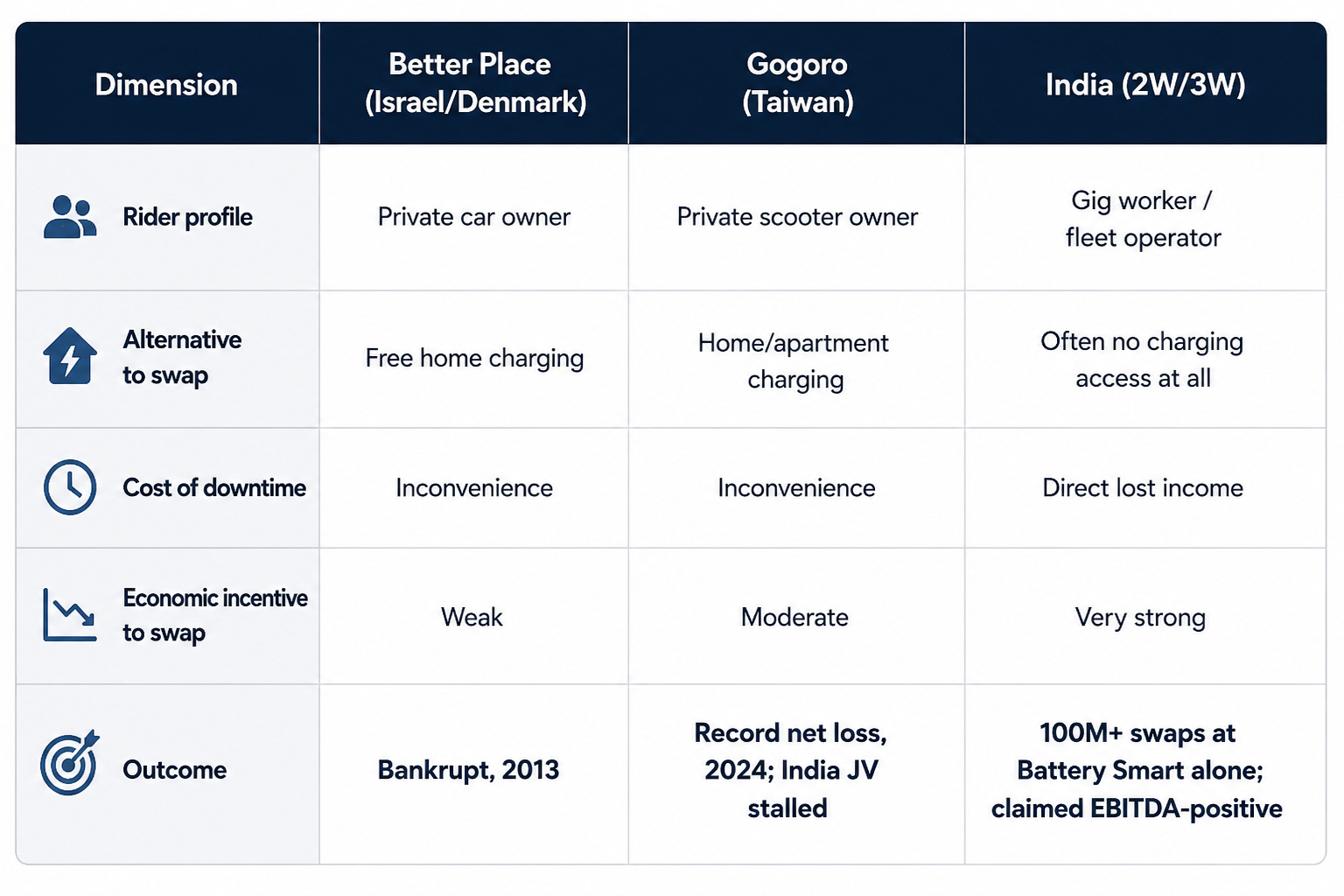
Battery swapping has been tried, at scale, by credible operators, and has mostly failed, for reasons specific to rich-country car markets. Better Place spent $850M on Israel and Denmark and filed for bankruptcy in 2013, betting on a single automaker and car owners with no urgency problem. Tesla built a working swap station in 2013 and never commercialised it, because supercharging solved the same anxiety more cheaply. Gogoro proved swapping works at national scale in Taiwan, but its 2025 financials show the strain of exporting that model: a record net loss in 2024, a Nasdaq delisting notice, and a stock near its all-time low. Swapping only works where the alternative is unacceptable, not merely inconvenient.
Why it works in India
India’s two and three-wheeler economy is the one large market where the alternative to swapping actually is unacceptable, for three structural reasons:
(1) the vehicle is a livelihood asset, not a lifestyle asset, a 90-second swap keeps a gig rider earning 14-16 hours a day, while a slow charge costs four to six hours of lost income,
(2) there is no garage to compete against in dense Indian housing,
(3) battery ownership was never going to be affordable at the point of purchase, since the battery can be 30-50% of an e-2W’s sticker price. The numbers back this up: Battery Smart has processed 100M+ swaps and claims operating breakeven on FY25 revenue of ₹249 crore (+52% YoY), SUN Mobility runs 900+ stations and 1.4M monthly swaps, Yuma Energy has completed 35M+ swaps across 2,000+ stations at a claimed 99% uptime.
It Comes Down to Weight
When NIO swaps a battery in Shanghai, a robot has to hoist out a pack heavier than a fully grown water buffalo, somewhere north of 500 kilograms, then slot in a replacement with millimeter precision. Pulling that off without a human ever leaving the driver’s seat takes a small fortune in sensors, computing power, and hydraulics, which is why each of those stations costs NIO roughly half a million dollars to build, and why Better Place burned through most of a billion dollars trying to do the same thing a decade earlier. Now picture the same job on a Bengaluru delivery rider’s scooter. The battery weighs about as much as a couple of bags of rice, light enough that the teenager working the swap counter hoists it out by hand and racks in a fresh one before the rider has finished checking their phone. No robot arm. No LiDAR. No million-dollar engineering problem to solve. Just a shelf, a charger, and a person, which is the entire reason a swap station in India can be built for a sliver of what NIO or Better Place had to spend. It’s easy to miss this because it sounds too mundane to be the answer, but it is the answer: India isn’t winning at battery swapping because it solved a harder problem than everyone else. It’s winning because two-wheelers handed it a much easier one, and every gig-economy dollar of urgency and every rupee of upfront affordability this report has already talked about got to stack neatly on top of that head start.
The policy scaffolding, and where it cracks
PM E-DRIVE (₹10,900 crore, live through Mar-2026/2028) offers 80-100% subsidy on swap-station upstream infrastructure. NITI Aayog’s draft Battery Swapping Policy (Feb-2022, still unfinalised) calls for Unique Identification Numbers, IoT monitoring, and AIS 156/038 safety certification, but keeps interoperability voluntary after OEM lobbying, so the market has predictably produced walled-garden networks rather than a shared grid. Separately, standalone lithium-ion batteries attract 18% GST versus 5% on a complete EV, an asymmetry that directly penalises the battery-as-a-service model this entire industry depends on and remains unresolved. CEEW’s own assessment calls out “policy and regulatory gaps, GST disparities, limited financing, absence of harmonised safety standards, interoperability and traceability challenges”, a list we’d price as a persistent regulatory drag rather than a problem with a fixed resolution date.
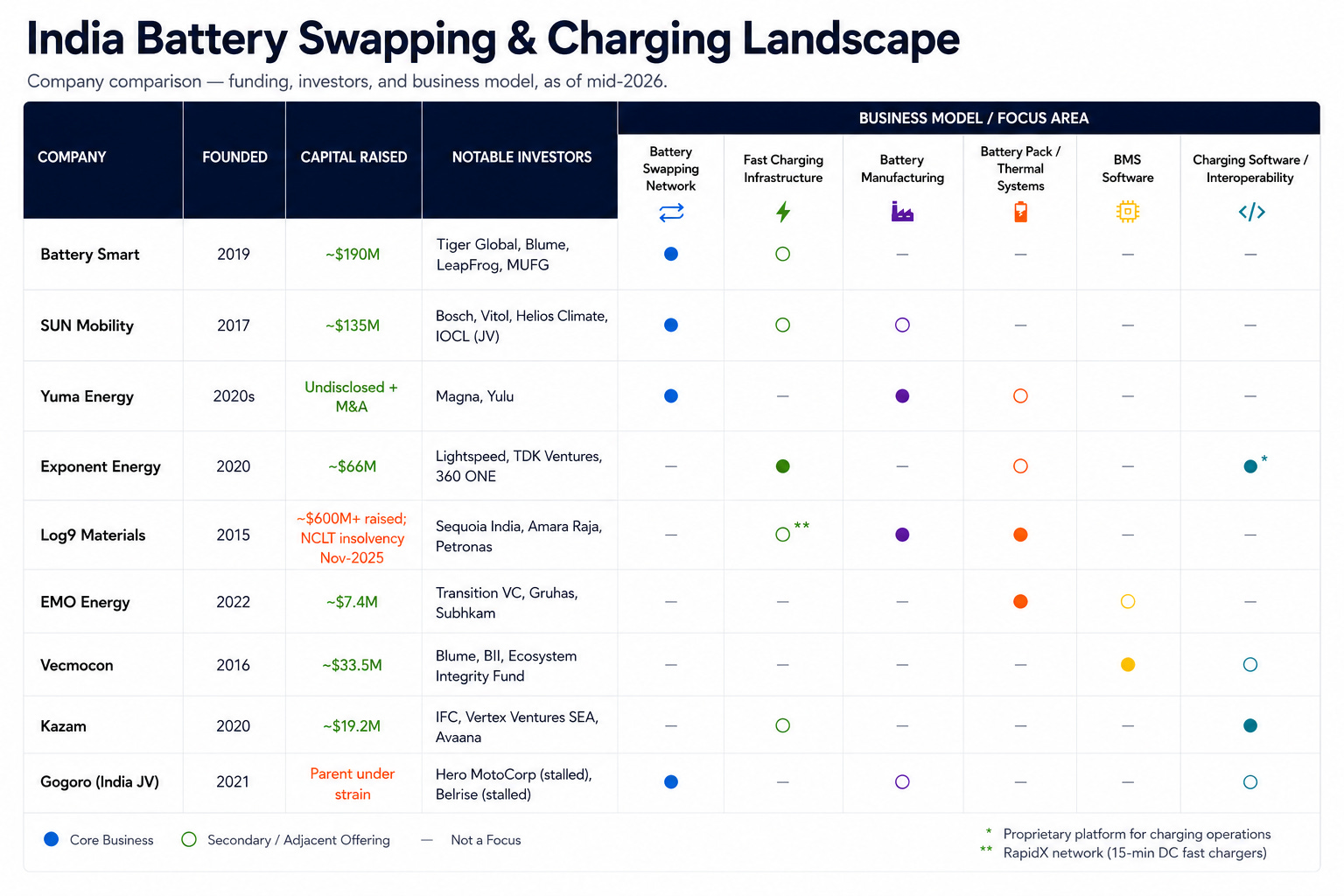
The operators
Part II - Specialised Batteries: Powering Drones, Robotics and Aerospace
The future of drones will not be won by drone manufacturers. It will be won by whoever solves endurance, payload, safety, and cold-weather reliability at the cell level.
The tender that got scrapped
The single most important data point in this article is a cancellation, not a funding round. In 2025, an Indian FPV drone tender was scrapped because 20-30 applicants could not demonstrate indigenous battery, motor, and flight-controller capability. India can design and assemble a competitive airframe, it cannot yet reliably source the battery that makes that airframe useful in a real theatre. This is not abstract: India’s tactical drone procurement opportunity has reportedly grown from ₹30-35B to ₹120-140B, with 75% of defence capital procurement now reserved for Indian companies. DRDO and Adani Defence delivered India’s first indigenous loitering munition (ULPGM) and an FPV kamikaze platform (AGNIKAA VTOL-1) to the Army in May 2026, every one of these programmes shares the same bottleneck, a battery that survives Himalayan cold and electronic-warfare conditions, sourced domestically.
What a drone battery has to do that an EV battery does not: maximise gravimetric (not volumetric) energy density, avoid thermal runaway with no chassis to contain a fire (1 in 50 drones reportedly fails from battery fire), support fast-charging or swappable packs for operational tempo, survive −30°C to +50°C, and clear aviation-grade, GPS-denied certification. Robotics and eVTOL impose related but distinct constraints (tens of thousands of high-current cycles, aviation-grade safety margins at the edge of what lithium-ion clears). In every case, the battery, not the airframe, is the limiting variable, which is why these companies are increasingly financed as defence-tech, not battery suppliers.
The chemistry landscape
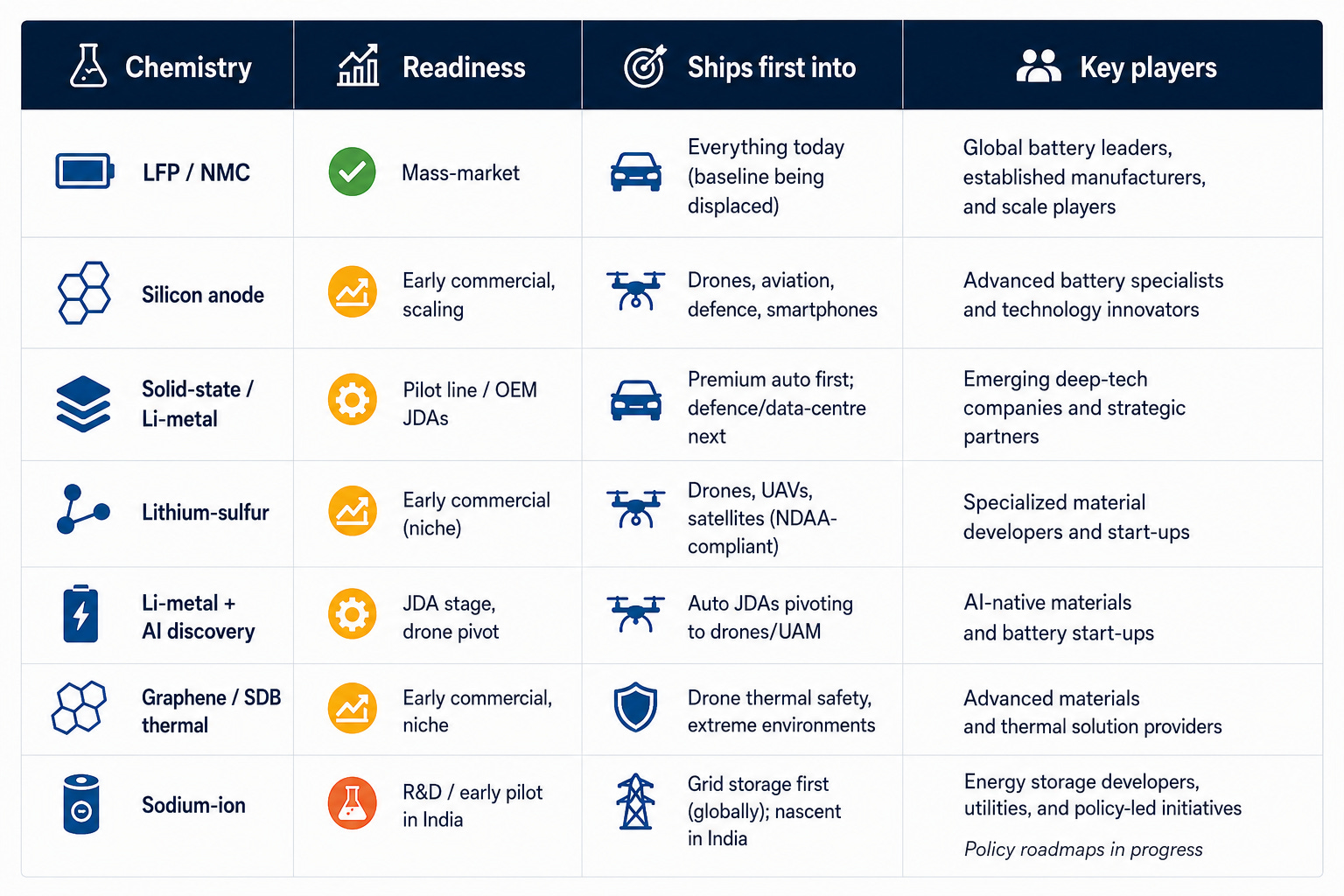
The highest energy-density chemistries, solid-state and lithium-sulfur, are being commercialised first into defence and aerospace, not mass-market EVs, because those buyers pay a premium for density and safety that a price-sensitive car buyer will not. Two more global names worth tracking: Solid Power, a slower-moving but well-capitalised solid-state licensor with automotive OEM ties, and StoreDot, the Israeli extreme-fast-charging specialist (also pursuing a SPAC listing) whose technology is explicitly positioned across EVs, phones, and military drones. Both reinforce the same pattern as the table above.
Mission-Critical Batteries
The biggest opportunity in India's battery ecosystem may not be manufacturing commodity cells, but building specialized batteries for applications where performance matters more than cost. Drones, defence, aerospace, and autonomous systems require batteries that operate across extreme temperatures, deliver higher energy density, and integrate advanced battery management software. These applications are less sensitive to price and more constrained by reliability, certification, and domestic sourcing. As India accelerates defence indigenisation and indigenous drone manufacturing, companies solving this niche could capture disproportionately high value despite representing a small share of overall battery demand. Globally, investors have already rewarded businesses focused on aviation and defence batteries, demonstrating that specialized chemistries and software can command significantly higher margins than conventional EV battery manufacturers.
The cell-manufacturing gap nobody says out loud
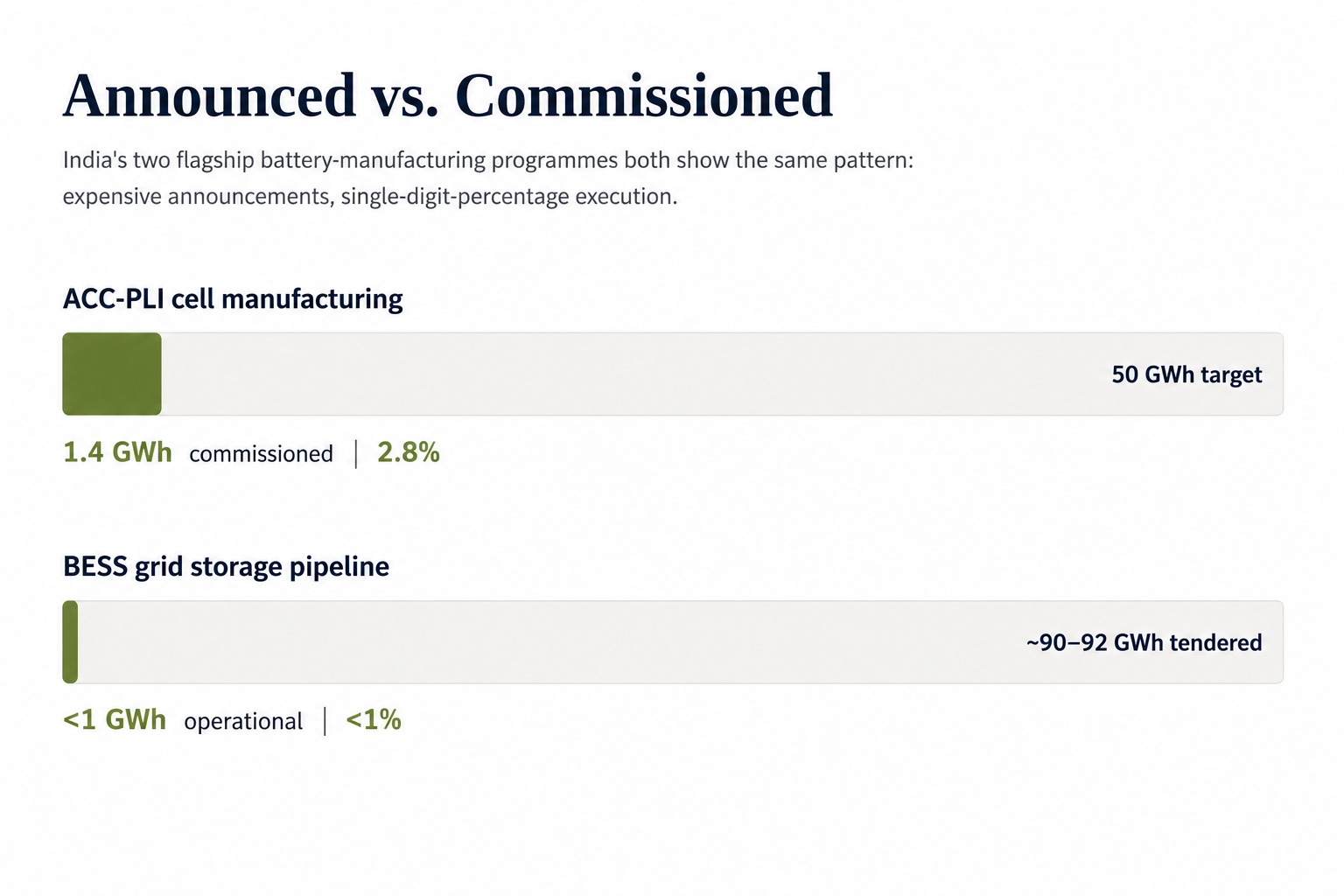
India’s ACC-PLI scheme aimed to build 50 GWh of domestic cell capacity on a ₹18,100 crore outlay. As of October 2025, only 2.8% (1.4 GWh) had been commissioned on schedule, entirely by Ola Electric, Hyundai withdrew its 20 GWh allocation, Ola itself scaled back to 5 GWh until FY2029. This matters for how to read every company above: it’s a headwind for manufacturing-heavy plays still built around imported cells, but a tailwind for recycling (Lohum, Attero) and chemistry-IP companies whose value never depended on India’s gigafactory ambitions arriving on time. Tellingly, in July 2026 the government re-tendered the scheme’s final 10 GWh earmarked specifically for grid-scale storage, not EV cells, an implicit admission of where near-term demand is actually certain. The CEA estimates India needs 411.4 GWh of storage by FY2031-32 (236.2 GWh from BESS), India’s BESS market is projected to grow from $2.05B (2026) to $8.59B (2031), over 90 GWh has been tendered. Yet under 1% of that pipeline was commissioned as of early 2026, the same execution gap, twice in a row.
Where the two theses meet
Both parts of this report are downstream of the same fact: India has an enormous, undercapitalised population of battery-powered machines, two-wheelers or drones, whose economics are constrained by the battery rather than the vehicle around it. Four rungs of the value ladder matter most in both: software/BMS (wins regardless of which hardware standard prevails), recycling and materials recovery (the chokepoint nobody has priced correctly, arguably a more realistic near-term import-substitution path than domestic cell manufacturing), chemistry and thermal IP (travels well, independent of India’s manufacturing execution risk), and fleet-or-defence-first go-to-market (every operator that built B2B and government relationships before chasing consumer scale is outperforming the one that tried to import a consumer-first playbook wholesale).
What we’d prioritise: software/BMS first for correlation-neutral exposure to category growth, recycling second for the resource-security tailwind, chemistry/thermal IP third for asymmetric upside decoupled from manufacturing execution risk and fleet-first hardware operators fourth, sized smaller given capex intensity and policy-calendar dependence.
What we’d size cautiously: consumer-first hardware plays without a fleet or government anchor customer already signed, pure cell-manufacturing bets dependent on ACC-PLI or BESS-tender timelines, and any operator, in either theme, whose unit economics haven’t been demonstrated beyond a single city or pilot fleet.
One sequencing note runs through nearly every company profiled above, and we think it is the most transferable lesson in this article, the operators that won in India did not start with a consumer brand and hope infrastructure followed. They started with a fleet, a government relationship, or a strategic distribution partner, and let consumer scale arrive later, if at all. That is true of Battery Smart’s early fleet focus, SUN Mobility’s IOCL joint venture, Yuma’s HPCL tie-up, and Dreamfly’s defence-adjacent client list. It is the exact inverse of how Gogoro tried to enter India, and we think it generalises to whatever the next battery-adjacent category in this market turns out to be.
The electric vehicle was the battery industry’s first customer, not its last. The investors who understand that the drone, the delivery bike, the humanoid robot, and the grid are all the same customer with different urgency levels will price this correctly years before the market does.
Until then we’ll keep looking where others don’t.
A clear second order beneficiary of the battery boom is specialty battery chemicals. Every EV battery depends on them.